Nagdhunga Tunnel Opens: What Nepal's First Road Tunnel Means for Your Bus Journey
For anyone who has ever sat in a bus on the Nagdhunga climb, engine groaning, cargo trucks crawling ahead in first gear, the same thought has probably crossed their mind: there has to be a better way out of this valley.
As of Monday, 27 July 2026, there is one.
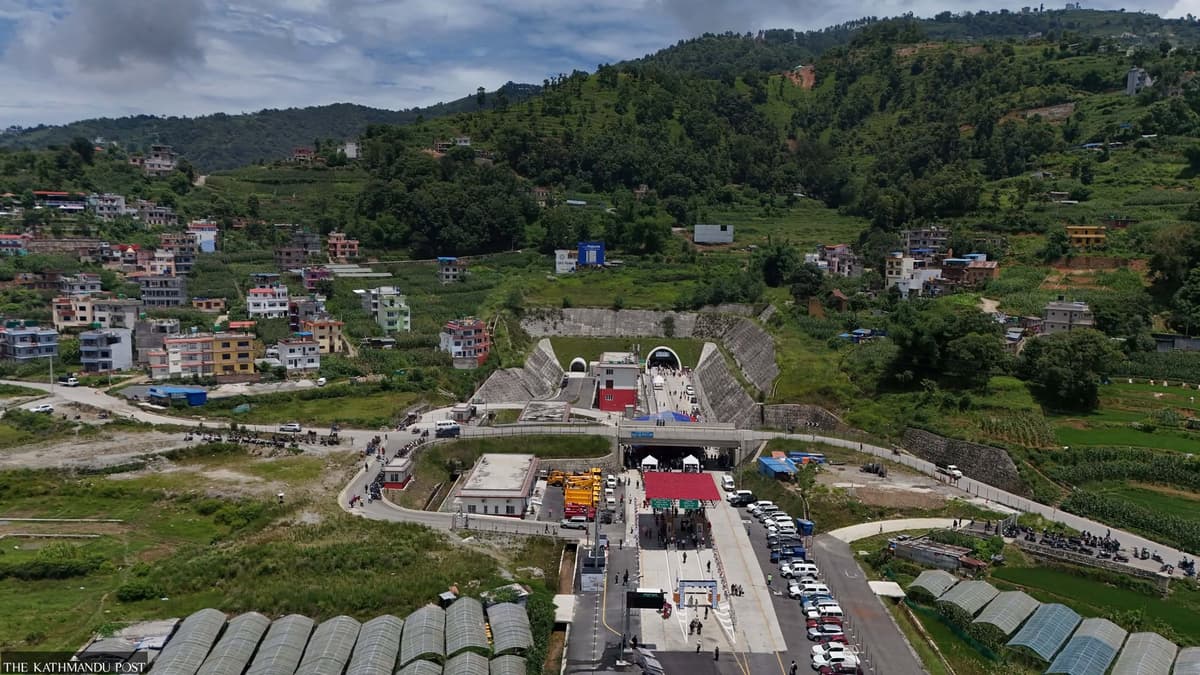
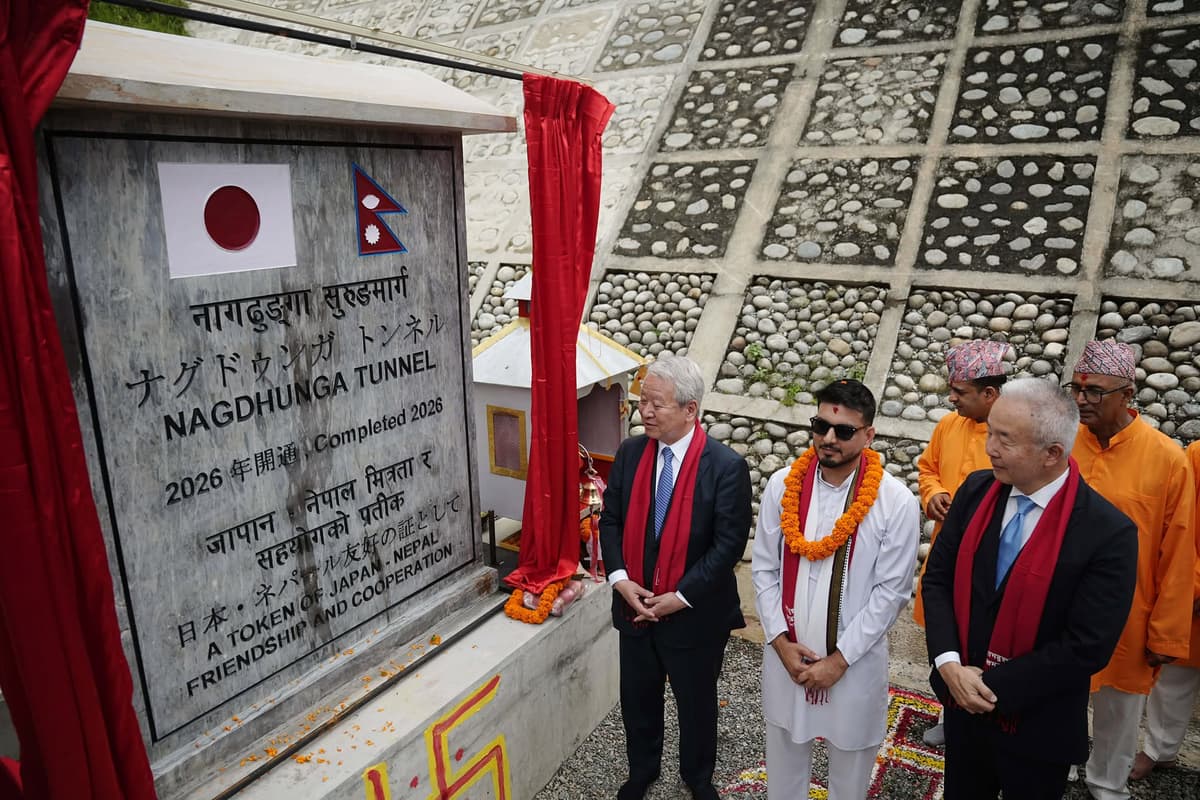
The Nagdhunga–Sisnekhola tunnel was formally inaugurated this morning at a ceremony attended by Minister for Infrastructure Development Sunil Lamsal, Japanese Ambassador to Nepal Maeda Toru, and Japan International Cooperation Agency (JICA) President Tanaka Akihiko. The three drove through the tunnel to mark its opening, after which the Japanese contractor formally handed the structure over to the Government of Nepal.
It is Nepal's first modern road tunnel built for regular vehicular traffic — and it sits directly on the western gateway that almost every long-distance bus leaving Kathmandu has to pass through.
Here is what actually changed today, what has not changed yet, and what it means if you are planning to travel west or south from the capital in the coming months.
The short version
Opened: 27 July 2026, at the western entrance to the Kathmandu Valley
Length: 2,688 metres (main tunnel), with a parallel 2,557-metre emergency escape tunnel
Route: Totipakha, Dahachok in Chandragiri Municipality–1, Kathmandu, to Sisnekhola in Dhunibesi Municipality, Dhading
Who can use it right now: ambulances, fire engines, security agency vehicles, and other essential service vehicles only
Everyone else: phased entry after a trial period of roughly three months, with public transport expected before private vehicles
Toll: free during the trial; charges by vehicle type once regular operation begins
Not allowed at all: pedestrians, motorcycles, scooters, three-wheelers, and any vehicle carrying petrol, diesel, gas or explosives
Why Nagdhunga was such a bottleneck in the first place
If you have only ever flown into Kathmandu, it is easy to underestimate this stretch of road.
The Nagdhunga pass sits on the western rim of the Kathmandu Valley at roughly 2,100 metres. Every bus heading to Pokhara, Chitwan, Butwal, Bhairahawa, Nepalgunj or Dhangadhi, every truck bringing goods up from the Terai, and every vehicle heading down toward the Indian border has traditionally had to grind its way over it. The existing Nagdhunga–Naubise road covers around eight kilometres and packs in something close to nineteen hairpin bends along the way.
On a good day that section takes around 30 minutes. On a bad one — a breakdown near a blind corner, a loaded truck that has lost momentum on the gradient, a festival exodus, monsoon rain — it can swallow an hour or more of your journey before you have even properly left the valley.
For a country where the Prithvi Highway is the single most important overland artery, that was an expensive daily tax on time and fuel.
How much time does the tunnel actually save?
This is where you should be a little careful with the headline numbers, because different sources are measuring different things.
The crossing itself is the dramatic part: the project has estimated that the run from Sisnekhola through to Balambu will take roughly seven minutes, against the 30 to 45 minutes the same stretch typically takes on the old road.
The overall journey saving is more modest and depends on what you drive. JICA's own project estimates put the saving at up to around 35 minutes for vehicles entering Kathmandu, with the largest gains going to heavy vehicles that suffer most on the climb. Nepali officials quoted around today's inauguration have described the saving as closer to an hour once congestion, gradient and the winding alignment are all accounted for.
A realistic expectation for a bus passenger, once buses are actually permitted through, is somewhere in the range of 30 to 60 minutes off a Kathmandu departure or arrival — with the biggest difference showing up on the days the old road would have been at its worst. That is not nothing on a route where the difference between arriving in Pokhara at 4 pm and 5 pm decides whether you see the lake at sunset.
There is a second, quieter benefit that matters just as much: predictability. A tunnel does not have hairpin bends, does not ice over, and does not lose a lane to a landslide scar. Journey times through this section should become far easier to plan around.
Who can use the tunnel right now — and who cannot
This is the part most people are getting wrong in the excitement, so it is worth being blunt about it.
The tunnel is not open to you yet.
According to Deputy Project Director Sanjay Panthi, only ambulances, fire engines, security agency vehicles and other essential service vehicles are permitted during this first phase. Authorities will run a trial period of roughly three months, assessing safety systems and traffic management, before other categories of vehicle are let in.
The phasing plan reported around the opening is interesting for anyone who travels by bus: after the initial emergency-vehicle stage, public transport vehicles are expected to be admitted before private vehicles. If that holds, bus passengers may well be among the first ordinary travellers to actually use the tunnel — ahead of private car owners.
Some categories are barred permanently, not just during the trial:
Pedestrians and cyclists
Motorcycles and scooters
Three-wheelers such as tempos and auto-rickshaws
Non-motorised vehicles
Tankers and vehicles carrying petrol, diesel, gas, or explosive materials
Oversized vehicles beyond the length, width and height limits set in the operating directive
Anything on that list continues to use the existing Nagdhunga–Naubise road, which stays open. So if you ride a motorbike to Pokhara, your route is unchanged.
Toll charges by vehicle type
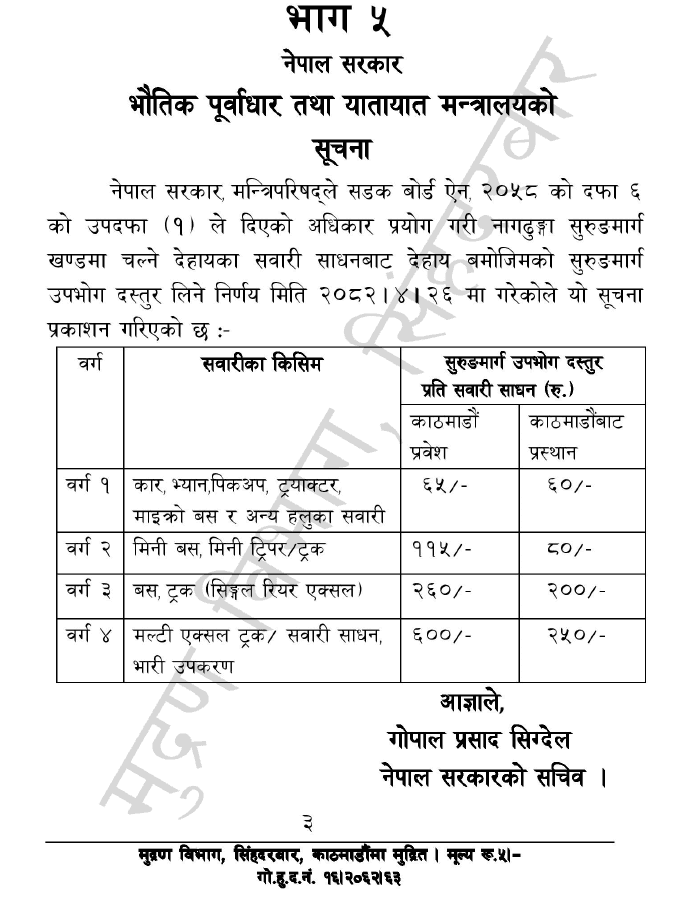
No toll is being collected during the trial period. Once regular operation begins, charges apply by vehicle class, and they are directional — entering the valley costs more than leaving it, because the uphill climb is where the tunnel saves the most time and fuel.
Vehicle type | Entering Kathmandu | Exiting Kathmandu |
|---|---|---|
Cars, vans, jeeps, pickups, microbuses and other light vehicles | NPR 65 | NPR 60 |
Minibuses, mini trucks and tippers | NPR 115 | NPR 80 |
Buses and single rear-axle trucks | NPR 260 | NPR 200 |
Multi-axle trucks, heavy vehicles and equipment | NPR 600 | NPR 250 |
For bus passengers, the practical impact is small. Spread across a full coach, a NPR 260 toll works out to a handful of rupees per seat. It is unlikely to move ticket prices in any meaningful way, though operators will naturally weigh the toll against the fuel and time they save.
What this means for travellers heading west and south
The Nagdhunga section is the shared first leg of an enormous share of Nepal's long-distance road network. Once the tunnel opens to public transport, journeys that should feel the difference include:
Kathmandu to Pokhara bus services along the Prithvi Highway, including tourist coaches, deluxe AC and semi-sleeper categories
Kathmandu to Chitwan bus routes toward Sauraha and Bharatpur
Kathmandu to Butwal bus and onward services into the western Terai
Kathmandu to Bhairahawa bus journeys for Lumbini and the Sunauli border
Kathmandu to Nepalgunj bus and Kathmandu to Dhangadhi bus overnight services on the long far-western runs
Cross-border services heading toward Indian border points via the same corridor
For the overnight far-western services in particular, an hour saved at the front of the journey is an hour of sleep gained at the other end.
What the tunnel does not fix
Honest expectations make for better trips, so it is worth naming the things this project does not solve.
It does not touch the Mugling–Narayanghat or Naubise–Mugling stretches, which carry their own congestion and their own monsoon landslide risk. It does not help with traffic inside Kathmandu itself, where getting from Thamel or Kalanki to the ring road can eat the time you just saved. And during heavy monsoon, highway disruption further west remains a real possibility regardless of how quickly you exit the valley.
The tunnel removes one specific, notorious bottleneck extremely well. The rest of the corridor is a separate conversation.
Seven years in the making: a short timeline
October 2019 — Foundation stone laid; construction begins under a 42-month contract
2020–2022 — Delays from the COVID-19 pandemic, land compensation disputes and material shortages
August 2023 — Breakthrough achieved on the emergency rescue tunnel
June 2024 — Breakthrough achieved on the main tunnel
2025 — Cabinet approves toll rates and the tunnel operating directive
May 2026 — Japanese contractor Hazama Ando Corporation completes and hands over construction
27 July 2026 — Formal inauguration, roughly 80 months after work began
The project was built with a concessional loan from the Government of Japan alongside investment from the Government of Nepal, with Nippon Koei serving as consultant. Total figures reported for the project vary between roughly NPR 25 billion and NPR 29 billion depending on whether land acquisition, compensation and exchange-rate-driven cost escalation are counted alongside the construction contract itself. Around 480 ropanis of land were acquired.
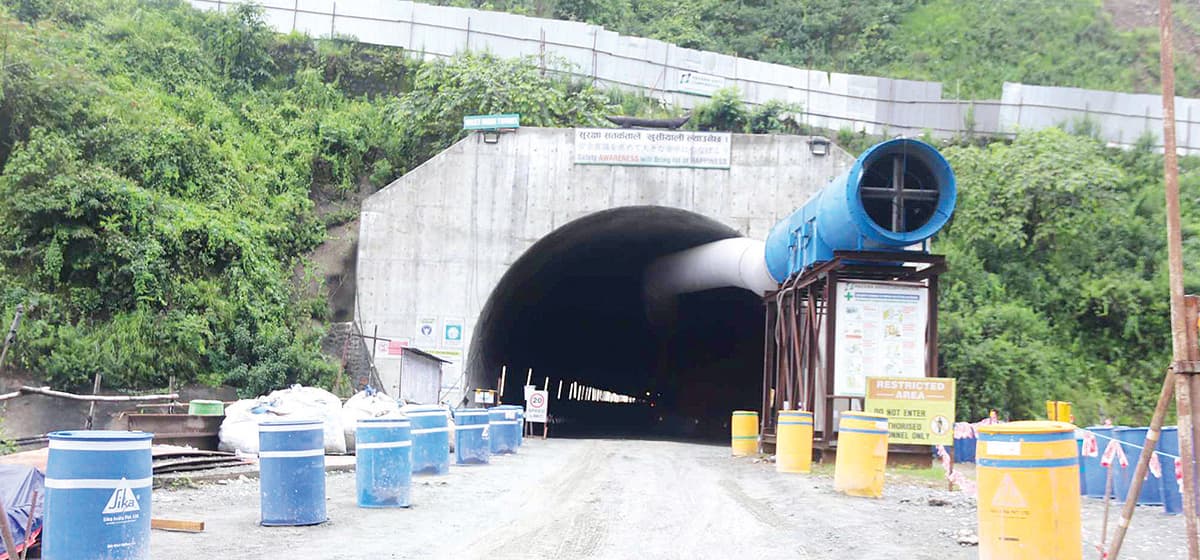
Inside, the tunnel is fitted with CCTV coverage, ventilation, fire suppression and emergency response systems, communication links and electronic toll collection. A separate parallel escape tunnel connected by cross passages handles emergency evacuation. Operations and maintenance have been contracted out for a five-year term, with a team of around 150 personnel running the facility around the clock, including the approach roads and the new Balambu flyover that ties the tunnel into the Tribhuvan Highway.
Practical advice for the next few months
If you are travelling west from Kathmandu between now and the end of the trial period:
Plan your journey as though the tunnel does not exist. Buses are not using it yet, and timetables reflect the old road.
Do not assume your ticket includes the tunnel. When services do transition, expect it to happen quietly and in stages rather than all at once.
Watch for Department of Roads announcements, not social media clips. There has already been confusion — videos of people walking around the tunnel area went viral before opening, and the project had to clarify that public access on foot is not permitted.
Motorcyclists should keep planning for the old road, permanently.
Book long-distance seats early during festival season. Dashain and Tihar demand on this corridor will not soften just because a tunnel exists.
Explore Nepal with GoMyGo
The Nagdhunga tunnel sits at the start of almost every major route out of Kathmandu, which makes it a useful moment to think about how you actually get on those buses in the first place. The corridor it feeds — Prithvi Highway to Pokhara, the Terai routes toward Butwal and Bhairahawa, the long hauls to Nepalgunj and Dhangadhi — covers most of the country's busiest intercity travel.
GoMyGo lets you browse and book those journeys online rather than queuing at a counter at Kalanki or Gongabu. The platform is available through the website and the Mobile App, with live seat inventory so you can see what is actually available on your travel date and pick your own seat rather than accepting whatever is left. Departure times, coach categories and boarding points are listed upfront, which helps when you are trying to line up an early departure against a connecting onward journey.
Payment is handled through the options most travellers to and within Nepal already use — eSewa, Khalti, IME Pay and fone Pay and ConnectIPS for domestic users, Indian UPI and PayPal for visitors. That matters on a corridor that carries a large share of Indian and international travellers alongside domestic passengers.
Confirmation arrives instantly by email and SMS, so you have your booking details before you reach the counter, and support is available if plans change. Given that highway conditions on this corridor can shift with weather and with the tunnel's phased rollout, being able to sort out a change quickly is worth more than it sounds.
Final Words
Nepal has talked about tunnels for decades. This morning, one of them opened.
It is worth keeping the achievement in proportion — the tunnel is 2.7 kilometres long, it is not yet open to you, and the road beyond Naubise is exactly as it was yesterday. But it is also worth recognising what it represents. A stretch of road that has frustrated travellers, drivers and freight operators for generations has been replaced by something that takes seven minutes to cross, in any weather, at any hour.
If the phased rollout goes as described, buses will be among the first to actually benefit. For anyone who has spent a hot afternoon watching the Nagdhunga bends inch past the window, that is a genuinely good piece of news — and a reason to be a little more optimistic the next time you plan a journey west.
Frequently Asked Questions
Written by
GoMyGo Team
The GoMyGo team covers Nepal travel, bus routes, booking tips, and everything you need for a smoother journey.