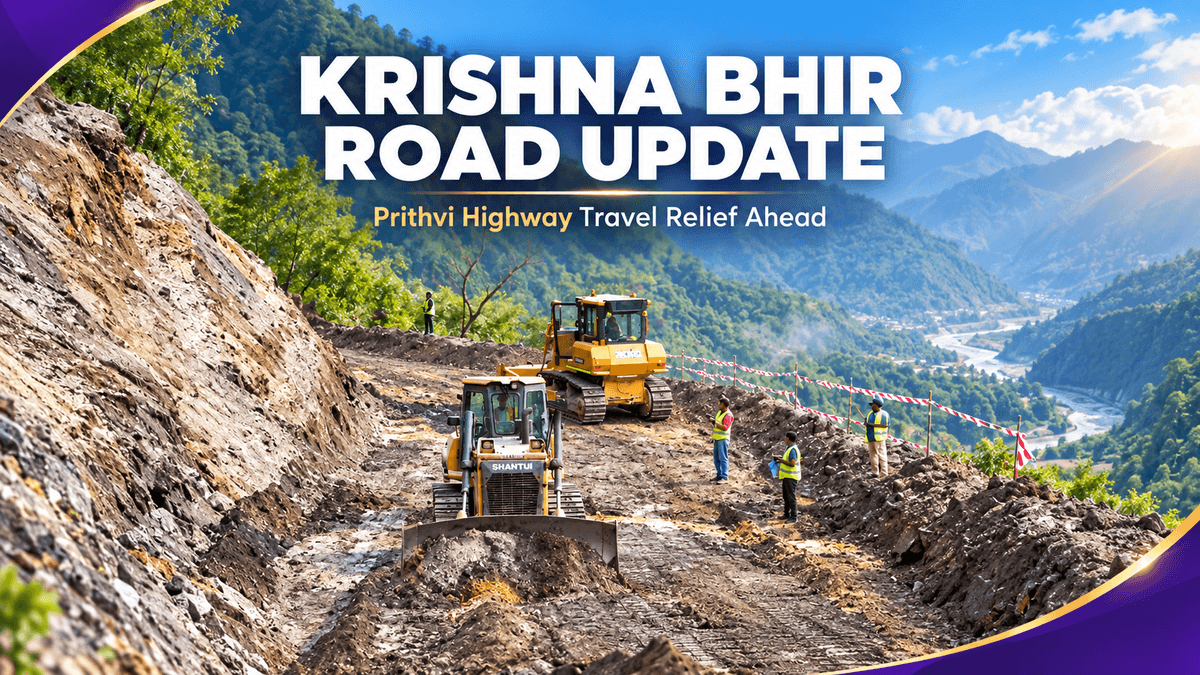
Krishna Bhir Road Update 2026: Prithvi Highway Set to Reopen from September 17
If you have travelled between Kathmandu and Pokhara, Chitwan or western Nepal at any point over the last two weeks, Krishna Bhir has probably stopped being just another place name on the highway.
It became the reason a normal bus journey turned into a long diversion. It became the reason large tourist coaches stayed parked. Smaller vehicles and Hiace services had to rely on longer alternative corridors. Freight and fuel vehicles were forced onto roads never designed to absorb this much traffic. And for passengers, the simple question — “Is the Kathmandu–Pokhara road open?” — suddenly stopped having a simple answer.
Now, finally, there is some relief in sight.
The Department of Roads is preparing to reopen the Krishna Bhir section of the Prithvi Highway from Ashoj 1, 2083 — September 17, 2026. A new 252-metre track has been cut into the hillside above the section that collapsed into the Trishuli River, heavy vehicles have already crossed it during a successful trial, and crews are completing the final gravel and drainage work before regular traffic begins.
That does not mean everything will instantly return to normal on Thursday morning. Krishna Bhir remains an active landslide zone, the new road is an emergency restoration rather than a permanent solution, and authorities may still control which vehicles move first.
But after weeks of disruption, this is the most important positive road update passengers have received since the flood.
The short version
What happened: Flooding and severe Trishuli River erosion caused the Prithvi Highway to collapse at Krishna Bhir on August 30.
Current status: The main section remains closed to normal traffic while final work continues.
New road: A roughly 252-metre, two-lane temporary track has been cut about 15 metres above the damaged highway.
Trial: Gas bullet tankers, trucks and several other vehicles have already crossed successfully.
Target reopening: September 17, 2026 / Ashoj 1, 2083.
Expected operation: The Department of Roads is preparing for two-way traffic, but essential-goods vehicles may receive first priority.
Important: Landslide risk remains, so the opening schedule can still change if new technical or weather problems appear.
How Krishna Bhir became the roadblock that changed travel from Kathmandu
The trouble started with the catastrophic Bhotekoshi flood in late August.
The August 26 disaster in Rasuwa sent an enormous flood surge downstream into the Trishuli river system. In the days that followed, elevated river flow continued eroding several sections of the Prithvi Highway.
At Krishna Bhir in Dhading, the Trishuli began eating away at the base of the highway itself.
By August 30, the damage became critical.
Early inspection found around 70 metres of highway had collapsed into the river, with another roughly 120 metres badly cracked. The wider affected zone eventually left around 300 metres of the corridor unusable for normal traffic.
This distinction matters.
It was not the usual Nepal highway problem where a landslide drops soil and rocks onto the road and excavators clear it away.
Part of the road itself was gone.
There was nothing to “clear”.
Engineers had to create another road.
Why the closure became such a big deal so quickly
Prithvi Highway is not simply another road connecting two towns.
It is one of Kathmandu Valley's main transport lifelines.
When traffic is normal, around 15,000 vehicles a day can pass through the Krishna Bhir corridor. Passenger buses, tourist coaches, trucks, fuel tankers and vehicles bringing food and everyday supplies into Kathmandu all depend heavily on this highway.
For passengers, it is the main overland connection between Kathmandu and places such as Pokhara, Chitwan, Butwal, Bhairahawa, Lumbini and much of western Nepal.
The closure therefore created problems almost immediately.
Tourist bus services were especially hard hit. Around 150 tourist buses on the Pokhara–Kathmandu corridor were left idle, while air travel between the two cities surged as passengers looked for alternatives. Broader tourist-bus operations connecting Kathmandu, Pokhara, Sauraha and Lumbini were disrupted for days.
For travellers who prefer road travel because it is more affordable than flying, the closure was more than an inconvenience.
It temporarily removed the country's most practical route.
What travellers have been doing instead
Nepal did not stop moving when Krishna Bhir closed, but journeys became much more complicated.
Large vehicles were redirected toward the Tribhuvan Highway via Naubise–Palung–Bhainse, while smaller vehicles and microbuses were allowed to use alternatives such as the Pharping/Kulekhani side depending on the route and prevailing traffic instructions. Other alternatives included the Kanti Highway, Hetauda-side roads and local connections across the Trishuli corridor.
Smaller vehicles naturally had more flexibility than a full-size tourist coach.
That difference has been very visible in bus operations.
Large luxury coaches cannot safely negotiate every narrow bend on local diversion roads. The Tourist Bus Association reported that only a handful of smaller tourist buses were able to continue on certain alternatives while most large coaches remained off the Kathmandu–Pokhara route.
From GoMyGo's side, the disruption was felt directly as well. While the normal highway connection remained broken, some Hiace and mini-vehicle services were shifted toward alternative corridors, including the Sindhuli side where the route and vehicle allowed it.
Those alternatives kept some passengers moving.
But they were never a true replacement for Prithvi Highway.
Longer distances meant more fuel, more driving time and more uncertainty. On some affected routes, alternative-road journeys were taking roughly twice the normal travel time.
That is why September 17 matters so much.
How engineers created a new road at Krishna Bhir
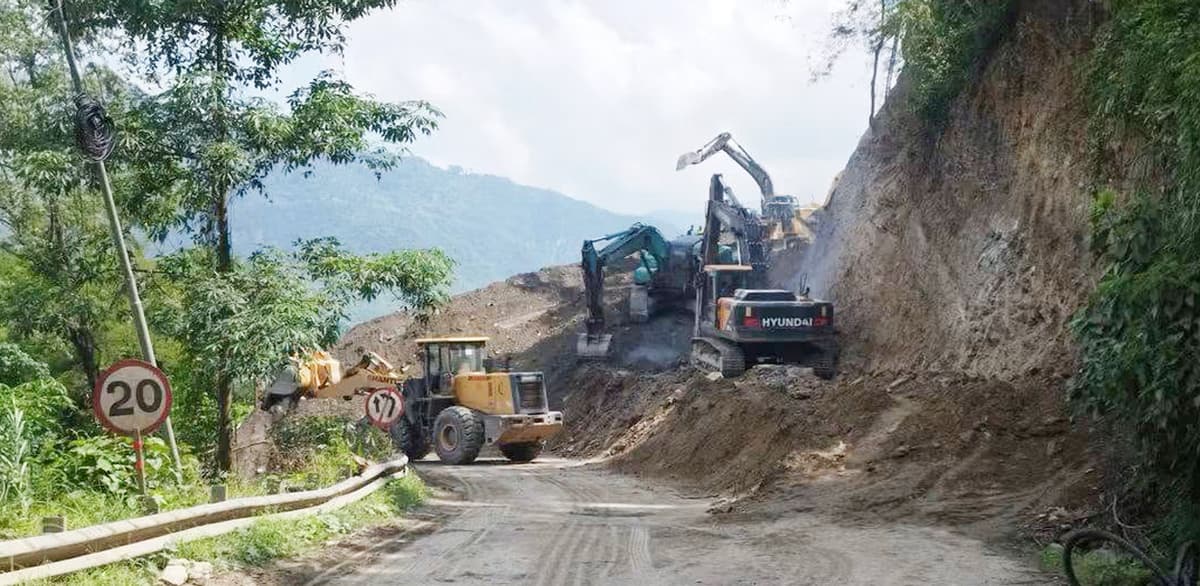
The immediate solution was surprisingly direct: move the highway farther into the hill.
Instead of trying to rebuild directly beside the swollen Trishuli, engineers cut a new alignment into the hillside above the collapsed section.
The resulting track is approximately 252 metres long and sits around 15 metres higher than the road destroyed by the river. The Department of Roads worked with the Nepal Geotechnical Society to assess the slope and design the emergency alignment.
At first, the plan was to create a single lane.
That track was then widened to allow two-way traffic.
Crews have been working with excavators, bulldozers and other heavy machinery for extended shifts. At one stage, around ten machines and 30 personnel were working 12 to 14 hours a day as the festival-season deadline approached.
The physical track is now there.
The remaining challenge is making it suitable for continuous traffic rather than simply proving that one vehicle can cross.
The first heavy vehicles have already crossed
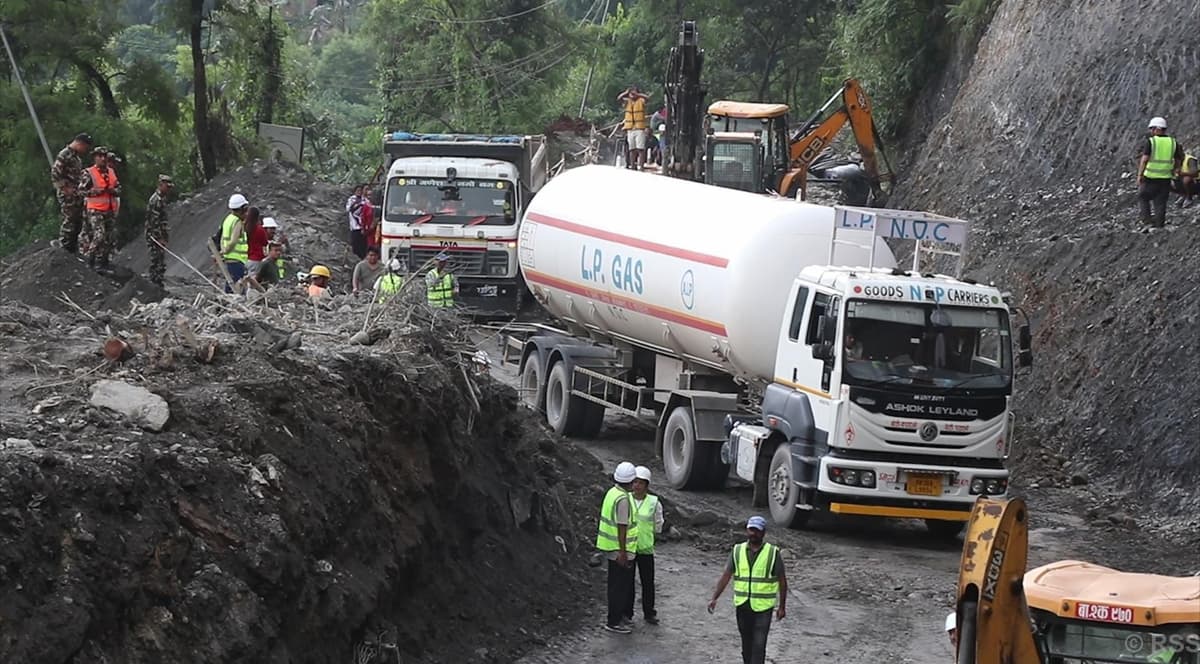
Sunday's trial was the moment officials needed to see.
Gas bullet tankers and other stranded heavy vehicles were sent through the new Krishna Bhir alignment.
They crossed successfully.
The trial confirmed that the newly cut track could physically handle large vehicles, but traffic was stopped again afterward because the road still requires finishing and safety work.
That distinction is important if you are travelling before September 17.
Seeing a video of a gas tanker crossing Krishna Bhir does not mean the highway has already reopened to regular buses.
As of September 15, normal public traffic is still restricted through the new section while crews finish the road.
What still has to be completed
The work now is less dramatic than carving a road through a hill, but probably more important for whether the track stays usable.
The Department of Roads says crews still need to complete graveling, sub-surface drainage and water-management work.
Krishna Bhir is an active landslide area. Water trapped inside the hillside can weaken the slope even when the weather appears calm.
Engineers therefore plan to use French drains and horizontal drilling to release water from inside the slope rather than allowing pressure to build.
The road will also remain under special technical monitoring after traffic begins.
And that is necessary because Krishna Bhir has history.
Krishna Bhir was a problem long before the 2026 flood
Older drivers know the name well.
Major landslide problems were recorded at Krishna Bhir from around 2056 BS onward, and a major slide in 2000 blocked the highway for 11 days. Bioengineering, retaining walls, micro-piling and other slope-control measures were later introduced to stabilise the area.
For years, those interventions helped keep one of Nepal's most infamous landslide areas under control.
The 2026 flood changed the problem.
Instead of only the mountain pushing down from above, the Trishuli began cutting the highway away from below.
Engineers are now dealing with both sides of the slope.
That is why the temporary track should be seen as a way to restore connectivity, not as proof that Krishna Bhir has been permanently fixed.
So, will the road definitely open on September 17?
The best answer today is:
That is the official target, provided conditions remain stable.
Department of Roads Director General Vijay Jaisi told Kantipur that if no new problem appears, the road should be ready for two-way traffic from Thursday, September 17. Technical teams will continue monitoring the site even after vehicles begin moving.
There is, however, one detail travellers should understand.
Officials had not yet made a final decision on September 14 about whether every category of vehicle would be released at once on the first day.
The Department of Roads has indicated that gas bullet tankers and vehicles carrying essential goods may receive first priority because Kathmandu's supply chain has also been affected by the closure.
So the headline is not:
“Every bus will definitely use Krishna Bhir normally from midnight on September 17.”
The accurate version is:
“The Department of Roads is preparing to reopen Krishna Bhir from September 17, with two-way operation planned and traffic likely to be normalised in stages if necessary.”
That may sound less dramatic.
It is also far more useful if you actually have a bus to catch.
What this means for Kathmandu–Pokhara buses
This is where passengers should feel the biggest relief.
The Krishna Bhir collapse effectively broke the main Kathmandu–Pokhara road connection for large tourist buses.
Pokhara's tourist bus fleet was among the industries hit hardest. Around 150 Kathmandu-bound tourist buses were sitting idle at one point, while the number of passengers flying between Kathmandu and Pokhara nearly tripled.
If the September 17 reopening works as planned, the main effect should be simple:
large coaches can start returning to the corridor they were designed to use.
That means fewer complicated diversions, better journey-time predictability and a much easier booking situation for travellers heading toward Pokhara.
It does not mean every departure will instantly return to its old timetable.
Queues may build during the first days. Freight traffic will be heavy. Road crews may still be working. Other sections of the Prithvi Highway remain vulnerable to weather and ongoing maintenance.
But restoring Krishna Bhir removes the single biggest break in the route.
If you regularly follow road developments on this corridor, our earlier guide to the Nagdhunga Tunnel opening is worth reading too. The two projects tell very different stories, but both directly affect how passengers enter and leave Kathmandu.
What about Kathmandu–Chitwan and western Nepal?
The effect is broader than Pokhara.
Many journeys toward Chitwan, Butwal, Bhairahawa, Lumbini and western Nepal use the same Kathmandu–Mugling transport corridor.
Some services managed the closure through Hetauda-side alternatives, while others were significantly disrupted.
Reopening Krishna Bhir should therefore take pressure off alternative highways and gradually return long-distance buses to more familiar routing.
For overnight buses heading much farther west, even removing one difficult diversion matters.
A passenger travelling to Nepalgunj or Dhangadhi already has a long night ahead.
Adding another few hours before the bus even reaches its normal highway is the kind of delay everyone notices.
What happens to the Hiace and mini-bus alternatives?
They do not disappear overnight.
One thing the closure demonstrated is that smaller vehicles can be valuable when large coaches cannot use the available road.
Hiace, micro and mini vehicles were able to use alternatives that were impractical for full-size buses. Some services also shifted onto the Sindhuli corridor where their destination and route made that feasible.
Once Krishna Bhir becomes stable enough for normal operation, the main highway will again make more sense for most westbound intercity traffic.
But operators may continue adjusting routes for some time.
During monsoon conditions, the safest route on Monday is not always the safest route on Tuesday.
Passengers should therefore check the actual bus and actual boarding information for their travel date, rather than assuming every operator has switched back simply because Krishna Bhir has reopened.
Searching for a bus counter number? Check the current trip, not an old Google result
This became especially important during the closure.
When schedules change, passengers naturally search things such as “Kathmandu to Pokhara bus counter number,” “Pokhara to Kathmandu bus contact number,” “Kathmandu to Chitwan bus counter,” or simply “bus counter number near me.”
That is useful search behaviour — but old phone numbers can become a problem.
Bus operators change counters, boarding points, staff numbers and sometimes even departure locations. During a road disruption, that can happen faster than Google updates an old page.
If you have booked through GoMyGo, use the operator/contact information attached to your current booking rather than relying on an old number copied from a years-old post.
For GoMyGo booking support, passengers can also contact:
WhatsApp Support: +977 9704-666777
That number is especially useful when a highway disruption affects your scheduled departure and you want to confirm whether your service is running before leaving home.
Should you travel immediately after the road reopens?
If you need to travel, the reopening is genuinely good news.
But the first few days deserve a little patience.
The new Krishna Bhir alignment is not an old, settled highway surface. It is a newly created emergency track through a historically unstable hillside.
Officials themselves have said that if landslides fall from above or technical problems appear, traffic decisions may need to change again.
So leave some buffer in your plan.
Do not schedule an important flight, appointment or international connection immediately after your expected bus arrival if you can avoid it.
And if the traffic police or road authorities stop vehicles temporarily, let them.
The goal is not simply to make the road fast again.
The goal is to make it usable without creating another emergency.
What is the permanent solution for Krishna Bhir?
Nobody wants to repeat this every monsoon.
That is why the temporary track is only one part of the work now happening around Krishna Bhir.
Officials are studying longer-term options including a tunnel, a pair of permanent bridges that would take traffic across the Trishuli, and upgrading the road on the opposite side of the river to bypass the unstable Krishna Bhir slope altogether.
Work has also begun on improving the alternative corridor across the Trishuli so Nepal has another option if the temporary Krishna Bhir track fails again.
That may ultimately be the bigger lesson from this disaster.
A highway carrying roughly fifteen thousand vehicles a day should not have its entire connection depend on one unstable slope.
September 17 solves the immediate problem.
The permanent solution still has to be built.
Explore Nepal with GoMyGo
The last few weeks have shown exactly why road information matters when booking a bus in Nepal.
A Kathmandu–Pokhara journey is not just a seat and departure time. The highway, weather, vehicle type, boarding point and route being used on that particular day all matter too.
With the Prithvi Highway preparing to reopen at Krishna Bhir, GoMyGo passengers should begin seeing travel on major western corridors become easier again.
Through the GoMyGo App and website, you can search available buses, compare departure times and vehicle categories, check boarding information and select your preferred seat before travelling.
During a road disruption, always check the current trip information before heading to the boarding point.
And if you are unsure whether your booked bus is operating, contact the operator shown on your booking or reach GoMyGo Support on WhatsApp at +977 9704-666777.
A road reopening is good news.
A confirmed bus is better.
Final Words
For more than two weeks, Krishna Bhir has been a reminder of how one short section of highway can change travel across half a country.
The Trishuli took away part of the road.
Large tourist buses stopped.
Passengers moved onto longer alternatives.
Hiace and mini vehicles tried routes that full-size coaches could not.
Fuel and essential goods took detours.
People who normally planned a Kathmandu–Pokhara trip around a bus departure suddenly had to plan around an entire highway.
Now the road is almost back.
A 252-metre new track, cut roughly 15 metres above the collapsed highway, has passed its first heavy-vehicle trial. Graveling and drainage work are being finished. If the hillside remains stable, the Department of Roads expects Krishna Bhir to begin carrying two-way traffic from September 17 — Ashoj 1.
It will not erase what the flood damaged.
It will not make every section of Prithvi Highway perfect.
And it is not yet Krishna Bhir's permanent solution.
But if you have spent the last two weeks asking when buses can finally use the normal road again, it is the update you have been waiting for.
The highway is coming back.
And for thousands of passengers, drivers and operators, that should make the next journey a little easier.
This article reflects information available on September 15, 2026. Krishna Bhir's September 17 reopening remains subject to slope stability, weather and final traffic-management decisions by the Department of Roads.
Frequently Asked Questions
Written by
GoMyGo Team
The GoMyGo team covers Nepal travel, bus routes, booking tips, and everything you need for a smoother journey.